
Bug of the Week: Cellar Spiders
Seeing long-legged spiders in your home? Learn what cellar spiders are, whether they’re dangerous, the truth behind the “daddy long legs” myth, and how to reduce them.
Cellar Spiders: The "Daddy Long Legs" Living in Your Home Right Now
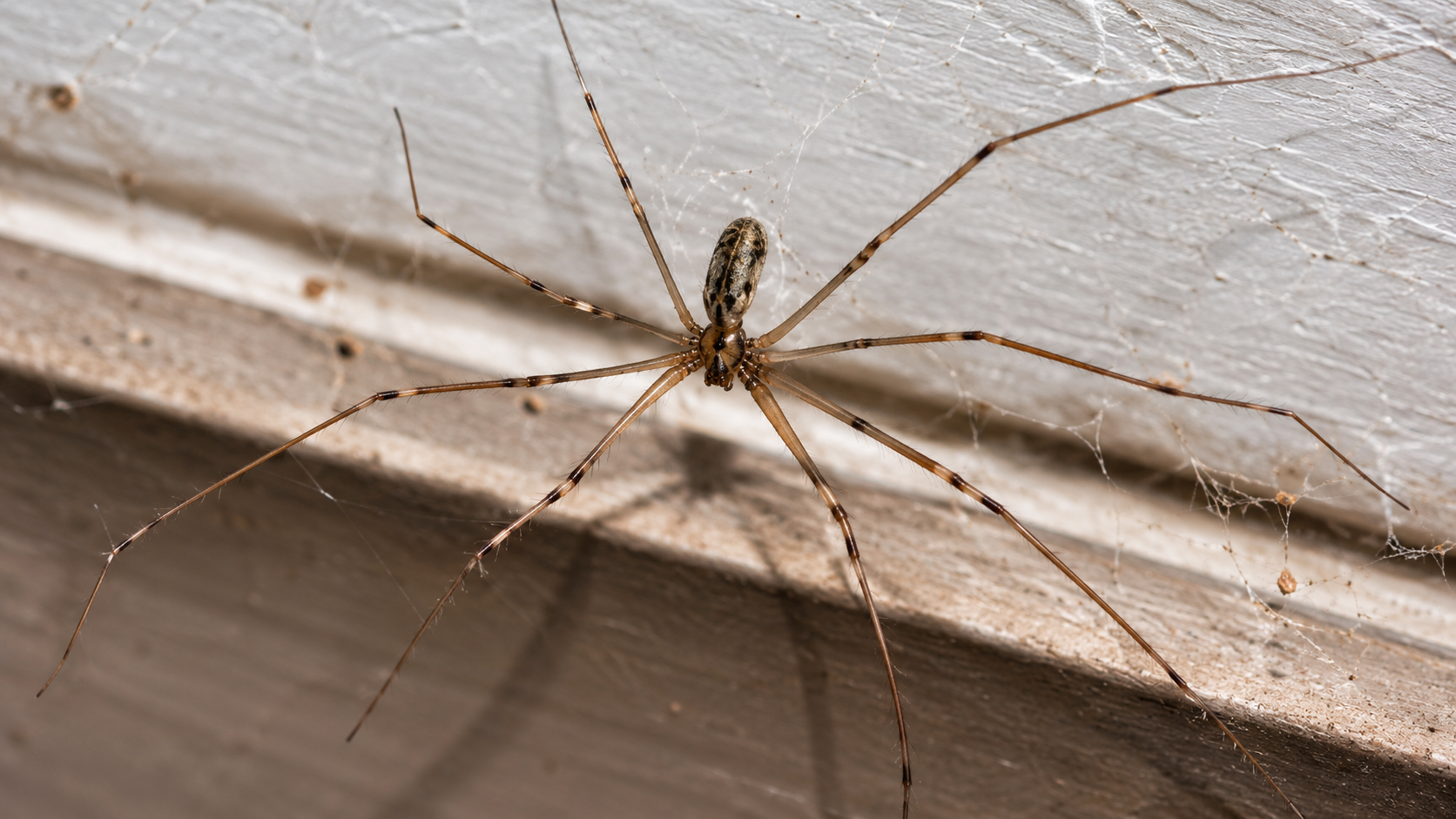
Look up in the corner of your garage, your back porch, or your bathroom ceiling and there's a good chance you'll find one — a small spider with impossibly long, thin legs hanging upside down in a loose, messy web. Most people call it a daddy long legs and walk away without giving it a second thought.
But there's actually a lot more to this spider than most people realize — including one of the most persistent and completely false myths in all of pest control. Here's the real story on cellar spiders and what they're doing in your Tampa Bay home.
What Is a Cellar Spider?
Cellar spiders belong to the family Pholcidae — a group of true spiders found on every continent except Antarctica. In Florida, the two species most commonly found in homes are Pholcus phalangioides , the long-bodied cellar spider, and Crossopriza lyoni , a tropical species that has become widespread across central and south Florida. Both are harmless, web-building spiders that prefer dark, undisturbed corners close to the ceiling.
Unlike the hunting spiders that move around your floors at night — like the wolf spider — cellar spiders stay put. They build a web, hang upside down in it, and wait for insects to wander in. When something does land in the web, the spider vibrates rapidly to tangle it further before moving in to feed. That shaking behavior is one of the most distinctive things about this spider and one of the easiest ways to confirm what you're looking at.
Wait — Is This a Daddy Long Legs?
Maybe. The name "daddy long legs" is one of the most confusing common names in all of entomology — and for good reason. Depending on who you ask and where they grew up, the name can refer to three completely different animals that happen to share one physical trait: very long, thin legs.
The name "daddy long legs" doesn't actually refer to just one organism. There are three main arthropods that commonly get lumped under the name. Here's what each one actually is:
- What It Is
- A true spider — has two distinct body segments, eight eyes, and spinnerets that produce silk for webs
- Bites?
- Technically capable, but venom is medically insignificant — essentially harmless to people
- Where You'll Find It
- Hanging upside down in a messy web in corners of garages, porches, and undisturbed rooms
- What It Is
- Spider-like arachnids, but not true spiders — harvestmen have a single rounded body because their cephalothorax and abdomen are fused, only two eyes, and they don't produce silk or have venom
- Bites?
- No — completely harmless; no venom, no fangs capable of piercing human skin
- Where You'll Find It
- Outdoors on walls, fences, and vegetation — rarely inside homes
- What It Is
- An insect, not an arachnid — crane flies have six legs, wings, and often look like oversized mosquitoes even though they don't bite or sting
- Bites?
- No — adult crane flies don't bite or sting anything; they live only long enough to reproduce
- Where You'll Find It
- Flying indoors near lights at night, especially during and after rain
Why does this matter? Common names aren't standardized, and one name can be used for completely different organisms depending on region, culture, or personal experience. When someone says "daddy long legs," they might be talking about a harvestman, a true spider, or even an insect. If you're trying to figure out what's in your home — or whether you need to do anything about it — knowing which animal you're actually looking at is the only way to get the right answer. The one in your ceiling corner with the messy web is almost certainly a cellar spider.
The Venom Myth — Let's Put It to Rest
This is one of the most repeated spider myths in existence — and it is completely false. This myth almost always refers to cellar spiders (family Pholcidae), since harvestmen don't have venom at all. While cellar spiders do have venom — like most spiders — there is no evidence that their venom is unusually potent or dangerous to humans. In fact, it's considered medically insignificant. Cellar spiders are not secretly deadly. Nobody knows exactly where this myth started, but it has been thoroughly debunked by arachnologists. The spider hanging in your garage corner poses no meaningful threat to you, your children, or your pets.
What Cellar Spiders Are Actually Doing in Your Home
Cellar spiders are passive predators. They build their web and let the insects come to them — and in Florida, there is no shortage of insects to catch. Mosquitoes, gnats, moths, and other small flying insects that make their way inside are all fair game. Cellar spiders will also occasionally catch and eat other spiders, including species that are actually more problematic, like brown widows.
In most cases, a cellar spider in your garage or on your back porch is doing more good than harm. The question of whether to remove them usually comes down to how many there are and where they're building their webs — a single spider in the corner of a utility room is very different from dozens of webs accumulating across an entire garage ceiling.
Florida's Common Cellar Spider Species
- Scientific Name
- Pholcus phalangioides
- Appearance
- Very long, thin legs with a small cylindrical pale gray or tan body; the most recognizable cellar spider in the world
- Web Type
- Loose, three-dimensional tangle web in corners near the ceiling — not the neat round orb webs people often picture
- Where Found
- Garages, basements, under stairwells, closets, and any dark undisturbed indoor space
- Scientific Name
- Crossopriza lyoni
- Appearance
- Similar long-legged profile but with a slightly more rounded, box-like abdomen; pale tan coloring
- Web Type
- Same loose tangle web style as the long-bodied species; often builds alongside it
- Where Found
- Very common throughout central and south Florida — frequently found in outdoor structures, porches, and sheds as well as indoors
- Scientific Name
- Spermophora meridionalis
- Appearance
- Much smaller than the other two species with a rounder abdomen; legs still proportionally long for its body size
- Web Type
- Smaller web, often in tighter spaces — behind furniture, inside cabinets, and along baseboards in damp rooms
- Where Found
- Bathrooms and kitchens more than other cellar spider species; attracted to moisture
Signs Cellar Spiders Are Active in Your Home
What to Do About Cellar Spiders in Your Home
A single cellar spider in a garage or utility room is catching other insects and keeping your space cleaner. If they're not in a high-traffic area, leaving them alone is a perfectly reasonable option.
If webs are accumulating in visible areas, a broom or vacuum handles them easily. Removing the web discourages the spider from rebuilding in the same spot — though it may move a few feet over.
Large numbers of cellar spiders indoors usually mean a larger insect population is feeding them. If webs are multiplying fast, the underlying insect activity is worth investigating.
How to Reduce Cellar Spider Activity in Your Home
- ✓ Reduce exterior lighting or switch to yellow or amber bulbs. Flying insects swarm toward white lights — fewer insects near your entry points means fewer inside, and fewer cellar spiders following them in.
- ✓ Seal gaps around doors, windows, and utility penetrations. Cellar spiders follow the insects that enter through these openings — the same sealing that reduces mosquito and gnat pressure also reduces spider activity indoors.
- ✓ Reduce humidity in problem areas. Dehumidifiers in garages, basements, and enclosed porches make the environment less hospitable for the insects cellar spiders prey on, which naturally reduces spider populations over time.
- ✓ Vacuum webs consistently in areas where they keep appearing. Regular removal of webs, egg sacs, and old spider debris prevents populations from growing and discourages rebuilding in the same spots.
- ✓ Call a professional if spider activity is widespread or if you're not sure what species you have. Cellar spiders are harmless, but brown widows — which can look somewhat similar at a quick glance — build similar messy tangle webs and are common in Tampa Bay. If you're finding spiders in large numbers and aren't certain of the species, a professional identification is worth it.
Seeing Spiders Throughout Your Home and Not Sure What They Are?
InsectIQ has an entomologist on staff who can identify exactly which spider species is active in your home and let you know whether any treatment is needed. Contact us today to get a quote.
Contact Us for a Quote