
These Fleas are driving me crazy! Insect IQ can Help!
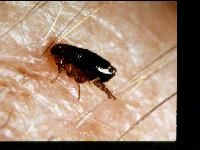
Fleas are tiny insects that measure about 1/16 inch or 16 mm in size. They have a dark, reddish-brown color and lack wings, relying on their ability to jump to move around. Their bodies are flattened from side to side, allowing them to navigate easily through the hairs on the host's body. With long legs perfectly adapted for jumping, fleas can cover considerable distances. The surface of their hard bodies is smooth and glossy, adorned with numerous backward-facing hairs and short spines. Adult fleas possess specialized mouthparts designed for extracting blood from their hosts.
In Florida, various species of fleas can become troublesome pests. Among them, the cat flea is the most commonly encountered. Cat fleas have a wide range of potential hosts, including dogs, humans, chickens, rabbits, squirrels, rats, and mice. While other flea species like the dog flea, human flea, and sticktight flea can also be found in Florida, it is possible for multiple flea species to infest a single animal.
BIOLOGY
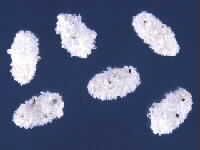
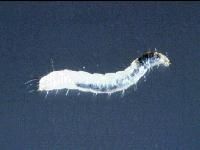
The female flea deposits her small, white eggs loosely on the host's hairs, feathers, or surrounding habitat. These eggs easily detach from the host and can be found on the ground, floors, bedding, or furniture. In the span of several months, some fleas can lay up to 500 eggs by laying batches of three to 18 eggs at a time. The tiny eggs hatch within one to 12 days after being laid. The hatched larvae, resembling white worms prefer darkness and primarily feed on dried adult feces. However, they may also consume deceased animal remains and other organic matter. In approximately seven to 14 days, assuming food has been abundant, the larvae complete their third stage of development and proceed to spin a small cocoon (as shown in Figure 4) where they enter the pupal stage. After about a week, the adult flea emerges from the cocoon and embarks on its quest for a blood meal.
Fleas can remain in the pupal stage anywhere from five days to five weeks when hosts are absent. They emerge as adults when vibrations from pets or humans signal the presence of a potential host. This explains why people returning to an unoccupied home may suddenly find themselves under attack by a swarm of fleas.
For reproduction, adult fleas rely on blood meals, but they can survive extended periods without feeding. Fleas tend to thrive and reproduce where pets typically rest, and individuals near these areas are also susceptible to flea bites. When fleas infest a home, they will feed on both humans and pets, often targeting the ankles and lower legs.
The so-called "sand-flea" is essentially a regular flea that breeds outdoors in the soil. Contrary to popular belief, fleas cannot go through multiple generations without consuming blood.
The complete life cycle of a flea can range from two weeks to two years. Egg laying is favored during hot and humid summer months, while hot and dry periods promote maximum adult production. Consequently, the highest populations of adult fleas typically occur in August to September.
CONTROL
Flea control poses challenges for pet owners as it typically requires two essential steps: (1) treating the pet and (2) treating the surrounding environment. Treating the pet alone is often effective as the animal can eliminate fleas and address infested premises. However, humans may still be bitten by fleas when they enter infested areas. To prevent flea bites, repellents can be applied to deter fleas from attacking.
Cat Flea Customer Prep List
Understanding the flea
1. Cat fleas are the most common flea found on both cats and dogs
2. The flea life cycle can be completed in as little as 16 days.
3. The adult flea can survive several months without a blood meal.
4. The female flea needs a blood meal in order to lay eggs.
5. Fleas spend little time on animals.
6. They prefer warm dark places (e.g., under cushions, carp or in dark corners)
Flea Control Animal
1. All flea control must be practiced on all animals in the household
2. Animals should be treated (flea dip) by a professional and scheduled during the residential flea treatment.
3. Launder pet bedding in hot water and dry hot
Residential Flea Treatment
1. Pick up items on the floor (e.g., books, toys, plants, pet bedding, under the bed, etc.)
2. Vacuum flea breeding areas as well as the entire residence. (vibration will stimulate all flea
Insect IQ Intensive Flea Treatment
1. Crack and crevice treatment will be performed to the entire residence. (e.g., floors, under beds, under couches and chairs. In addition, cushions of chairs and couches will be removed and the cracks and crevices will be treated)
2. Exterior broadcast treatments will be done to the yard. One treatment at the time of service and a second treatment 15 days later.
Or visit us at https://www.insectiq.com/contact-us
Insect IQ / Nutrilawn Pest Services 27 years
- DACS JB131270 Pest Control License Insect IQ
- DACS JF8248 1994 Certified Pest Control Operator
- DACS Certified Categories:
- Pest Control
- Lawn & Ornamental
- Termite
- Fumigation
- State of Florida Registered Beekeeper: FL0290619S
- 1994 UF Entomologist Jonathan Simkins
- 2020 UF Entomologist Britton Simkins