
Do You Hear Scratching Noises? Roof Rats In Florida.
What’s The Cost And How To Control?
Rats and mice enter houses and warehouses in Florida for both food and shelter. They eat just about any kind of foods that people are eating. The rats and mice also contaminate 10 times the amount of food that they eat, with urine, droppings and hair. They start fires by gnawing matches and electrical wires in homes and can cause serious damage. People deal with the most persistent populations of rats and mice both indoors and outdoors. Here’s what to look for.
ROOF RATS
In roof rats, nesting on the ground is uncommon, but they can be found nesting in attic spaces, roofs, palm trees, and shrubbery. Roof rats are climbers and prefer to nest off of the ground. They are destructive to citrus groves, as they live in citrus trees and gnaw on the fruit. They can be quite destructive in attics, gnawing on electrical wires and beams.


Roof rats generally prefer vegetables, fruits and grain; however, they eat ¼ to 1 ounce per day of food from various sources. Because they must have water to survive, roof rats also consume an ounce per day and may travel 100–150 feet from their harborages in search of water or food.
Color ranges from black to grizzled gray to tan with a lighter underbelly. The tail is a bit longer than the combined head and body. Adults weigh from ½ to pound. Their droppings are approximately 1/2 inch long and spindle-shaped. Roof rats live about 1 year and reach sexual maturity in 3–5 months. They have 6–8 offspring per litter and up to 6 litters per year.
IMPORTANT RAT BEHAVIOR
The movement of rats and mice is usually related to food, water, or harborage. Knowing where they are likely to go is important to controlling them.
Rats use any technique to get to food, water, or harborage. Their excellent sense of balance enables them to run on pipes, narrow ledges, and utility wires. Rats, especially roof rats, will climb anything their claws will hold on to, including wires, pipes, and rough walls. Because rats are exceptional swimmers, they often live in sewers, and occasionally enter homes through toilets.
Rodents prefer to use regular paths or runways along walls and behind debris. To get food in the open, they will run behind things to get as close to the food as possible. They are uncomfortable around strange objects or strange food and may avoid both. Rodents and mice frequently gnaw on their surroundings. Their teeth grow 4½ to 5½ inches per year and only gnawing keeps them short and sharp.
Rats and mice are mostly active at night. Rats have greatest activity during the first half of the night, if food is abundant. Mice have normally been active after dark both at night and between midnight and dawn. Rats and mice will be active during daytime hours if food is scarce, if there is an overpopulation of rodents, or when a poison has been used and the population is sick.
RECOGNIZING RAT AND MOUSE SIGNS
Since rats and mice are active at night and are rarely seen during the day, it is necessary to recognize signs of their activity.
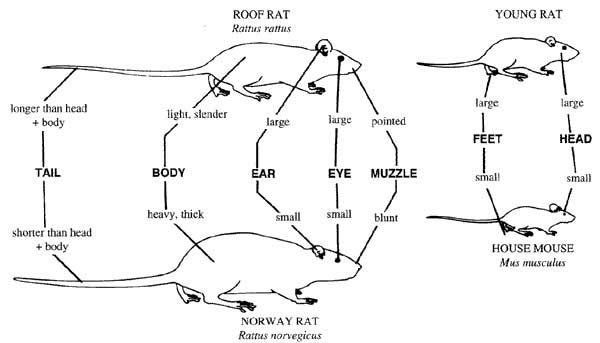
Droppings and Urine —Most homeowners first observe rodent problems by finding droppings or urine stains in and around buildings. Rodents usually have favorite toilet areas, but will void almost anywhere. Old droppings are gray, dusty, and will crumble. Fresh droppings are black, shiny, and puttylike. Rodents urinate while running, and the streaks are characteristic. The urine glows under ultraviolet lights, and glows blue-white if fresh.
Rubmarks —Along runways, smeary, black rubmarks appear from contact with the rodent’s body. Rubmarks on walls appear as black smudges left by the rodent. New rubmarks are soft and will smudge. Old rubmarks are brittle and will flake when scratched. Rafters may show swing marks of roof rats.
Sound— Usually rodent sounds are heard at night or in quiet areas. Rodents moving at night often scratch, gnaw and fight. The young often squeak while in the nest.
RODENT CONTROL
Rodentproofing— Rodentproofing is changing the structure of buildings in order to prevent entry of rats and mice. In considering rodentproofing, you must know that:
· Rats can squeeze through cracks ½ inch wide; mice, ¼ inch wide. Any place a pencil can be poked, a mouse can go.
· Rats can climb the inside of vertical pipes 1½–4 inches in diameter.
· Rats can climb the outside of vertical pipes up to 3 inches in diameter and any size if within 3 inches of a wall.
· Rats can jump vertically 36 inches, horizontally 48 inches, and reach horizontally or vertically 15 inches.
· Rats can jump 8 feet from a tree to a house if the branch is 15 feet above the roof.
We realize the importance of securing a dependable pest management firm to eliminate and control any pest population in all urban environments. Let Insect IQ take care of your wildlife problems. Here’s what we will do for you.
Critical Elements to Successful Animal Exclusions
✓ Key harborage sites and factors encouraging rodent build-up.
✓ Animal proofing by the physical elimination of all entry points and potential openings.
✓ A thorough inspection to identify the species involved.
✓ Population reduction by the use of live traps, sticky traps or other control measures
Interior Monitoring & Inspection
✓ For thirty-days, animal traps will be set in inaccessible areas.
✓ Traps will be checked once or twice/week for animal capture.
✓ After the thirty-days, the snap traps/live traps will be removed from the property.
✓ All animal exclusions are GUARANTEED FOR TWO (2) YEARS
We are confident that Insect I.Q., Inc., through the expertise and guidance of an Entomologist can provide you with the highest quality service available.
Intensive Exclusion
(1) a thorough inspection to identify the species involved, key harborage sites and factors encouraging rodent/animal build-up.
(2) recommendations for effective sanitation to deny rodents/animals food and harborage.
(3) rodent/animal proofing by the physical elimination of all entry points and potential openings through which rodents/animals can enter buildings.
(4) population reduction by the successful application of rodenticides, sticky traps or other control measures.
Interior Monitoring & Inspection
The interior monitoring will consist of an Integrated Pest Management (IPM) approach to rodent control. For thirty days (30) following the Intensive Exclusion (rodents only), rodent snap traps will be set throughout the entire building in inaccessible areas. These traps will be checked once or twice/week for rodents. After the thirty-day period, the snap traps will be removed from the building.