
What Kind of Flies Do I Have? A Florida Homeowner's Identification Guide

Jackson Simkins

Not sure what flies are in your Florida home? Identify fruit flies, blow flies, phorid flies & more — and learn what their presence really means
Florida Home Pest Guide

What Kind of Flies Do I Have? A Florida Homeowner's Identification Guide

You have flies in your home. You've tried something to get rid of them and they keep coming back. Here's the most common reason: you're treating the wrong fly.

Every fly species breeds in a different source. Fruit flies breed in fermenting produce. Blow flies breed near dead animals. Phorid flies can breed in a broken drain line beneath your foundation. If you eliminate the wrong source or treat for the wrong species, the flies never stop.

This guide will help you identify exactly what you're dealing with — and what it means for your home.

Why Fly Identification Matters in Florida

In most U.S. states, flies are primarily a warm-season problem. In Florida, they're a year-round one. Our heat and humidity accelerate fly breeding dramatically — a lifecycle that takes two weeks up north can be completed in just a few days here. That means a small problem can become a large one faster than most homeowners expect.

Getting the ID right is the first step. The second step is finding the breeding source. Without both, you're just managing symptoms.

Filth Breeding Flies: The Most Serious Category

Filth-breeding flies are species that breed in decaying organic matter, animal waste, or carrion. Their presence isn't just a nuisance — it's a health concern. These flies move directly from contaminated breeding sources to your food prep surfaces, transferring bacteria with every landing.

If you have filth-breeding flies inside your home, there is an active source driving them. Finding and eliminating that source is the only permanent fix.

🊰

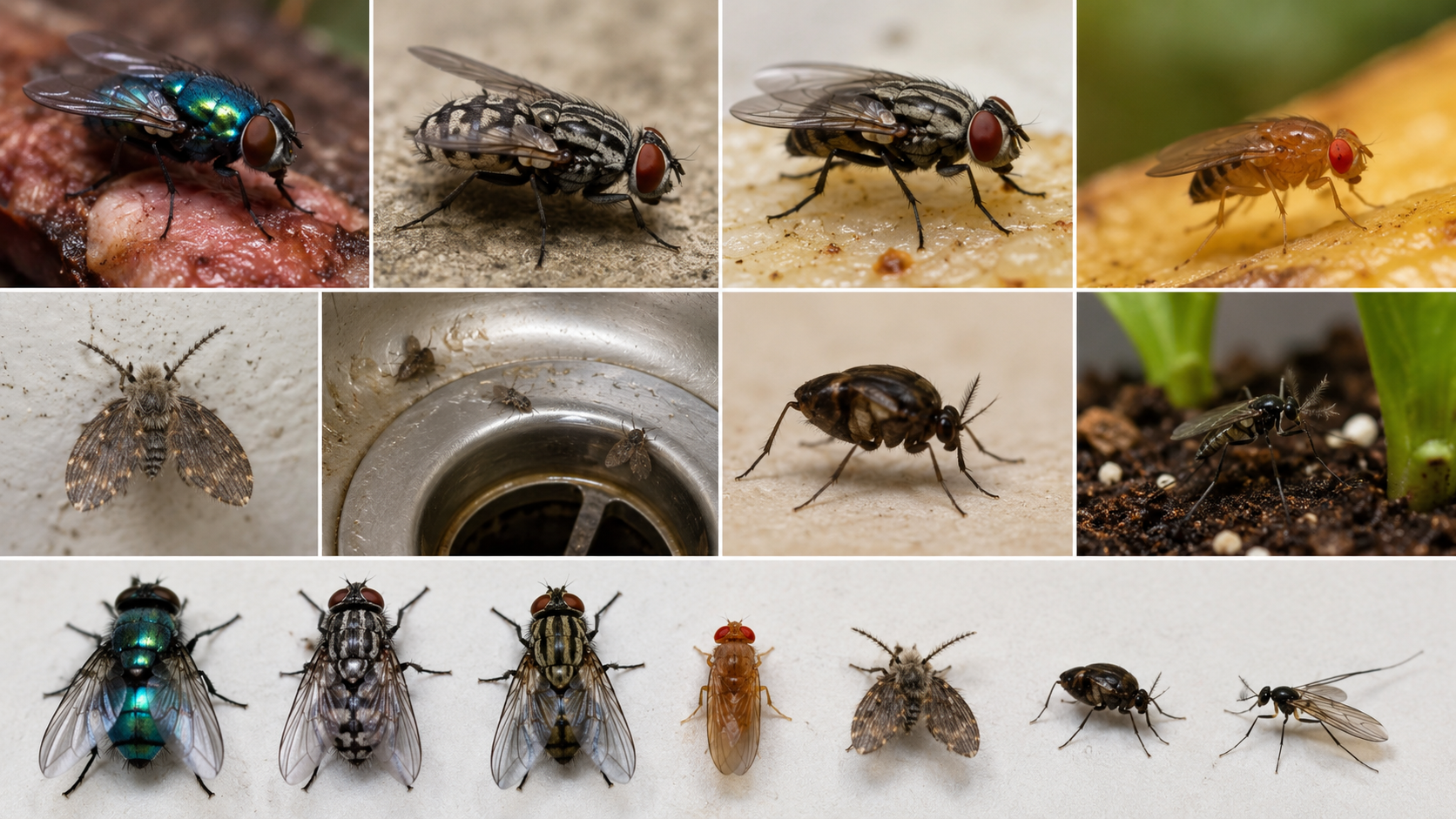
Blow Flies & Bottle Flies

Appearance Large, shiny, and metallic — blue, green, or bronze with a distinctive iridescent sheen in direct light. Noticeably bigger than a house fly.
Breeds In Carrion and rotting meat. A sudden indoor infestation with no obvious food source almost always signals a dead animal in a wall void, attic, or beneath the home.
Why it matters: Blow flies are exceptional at detecting decay — even through walls — and transfer pathogens from the decaying source to surfaces throughout your home. Treat this as an investigation, not just a pest problem.
ðŸŠģ

Flesh Flies

Appearance Gray and black with a bold checkered abdomen and red eyes. Slightly smaller than blow flies but larger than a house fly — often mistaken for house flies at a glance.
Breeds In Carrion, feces, and decaying organic matter. Unusually, they give birth to live larvae rather than laying eggs, allowing infestations to develop faster.
Why it matters: An indoor flesh fly infestation is a red flag for a hidden decay source. They are known carriers of pathogens and parasites.
ðŸĶŸ

House Flies

Appearance Dull gray body, four dark stripes running along the thorax, bright red compound eyes. This is the fly most people picture.
Breeds In Garbage, animal feces, food waste, and compost. They typically enter from outside through gaps around doors, windows, and screens, drawn in by food odors.
Why it matters: House flies are known to carry over 65 illnesses, including Salmonella and E. coli. A persistent indoor population usually points to an outdoor breeding source very close to the home — an uncovered trash can, a pet waste area, or a compost pile near an entry point.

Small Flies: The Ones Breeding Inside Your Home

Small flies are a different category entirely. Rather than entering from outside, these species are breeding inside your home, which means the infestation will continue regardless of how well you seal entry points — because the source is already indoors.

🍌

Fruit Flies

Appearance Tiny (~3mm), tan or brown body with distinctive bright red eyes. Slow, hovering flight pattern around produce and drains.
Breeds In Fermenting organic matter — overripe fruit, spilled sugary liquids, recycling bins, and the thin film of organic buildup inside slow or infrequently used drains.
Key tell: Concentrated in the kitchen around produce, alcohol, or sink drains. If you only see them near drains rather than produce, you may actually have drain flies.
ðŸšŋ

Drain Flies

Appearance Tiny and fuzzy, with broad moth-like wings held flat over the body like a tent. Usually gray or tan. They hop and flutter short distances rather than flying fast.
Breeds In The organic film inside drains, pipes, and sewage areas. Bathroom drains, floor drains, and rarely-used sinks are the most common sources. The film can be invisible to the naked eye.
Key tell: Small fuzzy moth-like insects resting motionless on bathroom walls in the morning are almost certainly drain flies.
⚠ïļ

Phorid Flies

Appearance Very small, tan or dark brown, with a distinctively humped thorax (hunchback silhouette). Their most recognizable behavior is running rapidly across surfaces rather than flying.
Breeds In Decaying organic matter — but critically, they are one of the only small fly species that will breed in a dead animal inside a wall void or in sewage leaking from a cracked drain line beneath a concrete slab.
Key tell: A small fly infestation near floor level, baseboards, or the base of kitchen cabinets that does not respond to fruit fly or drain fly treatment is a strong indicator of phorid flies. The source needs to be found professionally.
ðŸŠī

Fungus Gnats

Appearance Very small and dark with long legs and a mosquito-like silhouette. Weak, slow fliers — often seen hovering near soil or flying up when a plant is disturbed.
Breeds In Moist potting soil containing decaying organic matter. A houseplant pest, not a structural one. Can also appear after new sod or landscaping soil is brought near the home.
Key tell: Small flies appearing only near houseplants or windows adjacent to plants. Harmless to humans but can damage plant roots in large numbers.

Florida Fly Identification at a Glance

Fly Type Size Distinctive Feature Most Likely Breeding Source
Blow Fly Large Metallic blue/green sheen Dead animal, rotting meat
Flesh Fly Med–Large Gray/black checkered abdomen Dead animal, feces
House Fly Medium Dull gray, four thorax stripes Garbage, pet waste, food scraps
Fruit Fly Tiny Red eyes, tan/brown body Fruit, drains, recycling bins
Drain Fly Tiny Fuzzy, moth-like wings Drain organic film
Phorid Fly Tiny Humped back, runs across surfaces Decaying matter, broken drain lines
Fungus Gnat Tiny Mosquito-like, hovers near plants Moist potting soil

When to Call a Professional About Flies in Your Florida Home

Not every fly situation requires a professional — but some absolutely do.

🙋

Handle It Yourself

  • Fruit flies from produce or recycling bins (remove the source, clean drains with an enzyme cleaner)
  • Fungus gnats (let soil dry between waterings, use yellow sticky traps)
📞

Call a Professional

  • Drain flies that persist after cleaning (buildup may be deeper than DIY products can reach)
  • Any indoor infestation of blow flies or flesh flies (a dead animal in the structure needs to be located)
  • Phorid flies near floor level or baseboards (possible broken drain line or hidden decay source)
  • Any fly infestation that returns despite source elimination

In Florida's climate, a hidden breeding source — a dead rodent in a wall, organic buildup in a drain line, a cracked sewer pipe — can sustain a fly infestation indefinitely. Professional inspection identifies the source, not just the symptom.

Stop Guessing and Start Solving

The right treatment starts with the right identification. If you're seeing flies in your Florida home and can't locate the source — or if an infestation keeps returning despite your efforts — Insect IQ can help. We identify the species, locate the breeding source, and treat the problem at its root.

Schedule Your Inspection

Proudly serving Tampa, Clearwater, St. Petersburg, Sarasota, and surrounding Tampa Bay communities.

By Jackson Simkins May 11, 2026
Yellow patches spreading in your lawn? Learn the signs of chinch bugs in Florida and how to stop damage fast.
By Jackson Simkins May 8, 2026
Tiny white ants taking over your Florida kitchen? Learn how to identify ghost ants, why they keep coming back, and how to stop them
By Jackson Simkins May 5, 2026
Lovebugs are swarming in Florida. Learn why they appear, what attracts them, and how to protect your car and home during peak season.
By Jackson Simkins May 1, 2026
Learn what palmetto bugs really are, why they enter Florida homes, and how to keep these giant roaches out for good.
By Jackson Simkins April 27, 2026
Ticks are active in Florida now. Learn why and how to control them with effective prevention and treatment methods.
By Jackson Simkins April 24, 2026
Learn how to spot, prevent, and control carpenter bees in Florida before they damage your home. Expert solutions available.
By Jackson Simkins April 22, 2026
Learn what occasional invaders are, why they enter Florida homes, and how to prevent pests like boxelder bugs and lubber grasshoppers.
By Jackson Simkins April 17, 2026
Struggling with fleas in Florida? Learn how infestations start and how to eliminate them fast with expert pest control solutions.
By Jackson Simkins April 13, 2026
Discover what attracts cockroaches in Florida homes, including food, moisture, and hiding spots. Learn how to prevent infestations and keep roaches out for good.
By Jackson Simkins April 10, 2026
Celebrate National Pest Management Month by protecting your Florida home from ants, roaches, rodents, and more. Learn why professional pest control is essential year-round.